Article by Catherine Choi in The Ringing World, 20 November 2026
Transcribed below:
I came to learn about bellringing thanks to a project in my second year of university. As anthropology students, we had to carry out an ethnographic study of a topic of our choice, in order to learn how to conduct research and write up fieldwork notes.
During my search for a topic to study I stumbled across bellringing. Despite living within walking distance of a church with a bell tower for almost two decades, I had somehow never realised that ringing was done by people! When I saw the Kingston Bell Ringers on the All Saints’ Church website. I was immediately intrigued.
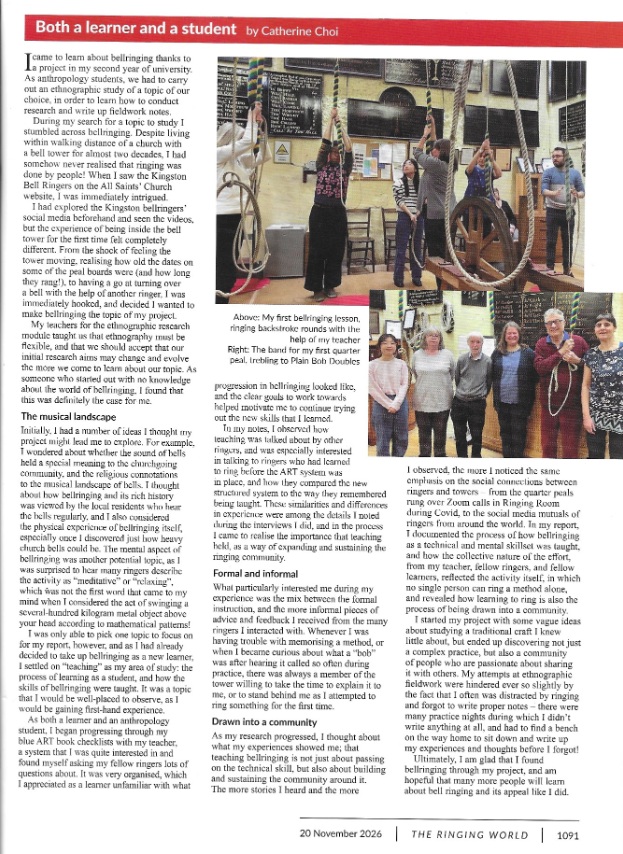
I had explored the Kingston bellringers’ social media beforehand and seen the videos, but the experience of being inside the bell tower for the first time felt completely different. From the shock of feeling the tower moving, realising how old the dates on some of the peal boards were (and how long they rang), to having a go at turning over a bell with the help of another ringer, I was immediately hooked, and decided I wanted to make bellringing the topic of my project.
My teachers for the ethnographic research module taught us that ethnography must be flexible, and that we should accept that our initial research aims may change and evolve the more we come to learn about our topic. As someone who started out with no knowledge about the world of bellringing, I found that this was definitely the case for me.
The musical landscape
Initially, I had a number of ideas I thought my project might lead me to explore. For example, I wondered about whether the sound of bells held a special meaning to the churchgoing community, and the religious connotations to the musical landscape of bells. I thought about how bellringing and its rich history was viewed by the local residents who hear the bells regularly, and I also considered the physical experience of bellringing itself, especially once | discovered just how heavy church bells could be. The mental aspect of bellringing was another potential topic, as | was surprised to hear many ringers describe the activity as “meditative” or “relaxing”, which was not the first word that came to my mind when I considered the act of swinging a several-hundred kilogram metal object above your head according to mathematical patterns!
I was only able to pick one topic to focus on for my report, however, and as I had already decided to take up bellringing as a new learner, I settled on “teaching” as my area of study: the process of learning as a student, and how the skills of bellringing were taught. It was a topic that I would be well-placed to observe, as | would be gaining first-hand experience.
As both a learner and an anthropology student, I began progressing through my blue ART book checklists with my teacher, a system that [ was quite interested in and found myself asking my fellow ringers lots of questions about. It was very organised, which I appreciated as a learner unfamiliar with what progression in bellringing looked like, and the clear goals to work towards helped motivate me to continue trying out the new skills that I learned.
In my notes, I observed how teaching was talked about by other ringers, and was especially interested in talking to ringers who had learned to ring before the ART system was in place, and how they compared the new structured system to the way they remembered being taught. These similarities and differences in experience were among the details I noted during the interviews I did, and in the process I came to realise the importance that teaching held, as a way of expanding and sustaining the ringing community.
Formal and informal
What particularly interested me during my experience was the mix between the formal instruction, and the more informal pieces of advice and feedback I received from the many ringers I interacted with. Whenever I was having trouble with memorising a method, or when I became curious about what a “bob” was after hearing it called so often during practice, there was always a member of the tower willing to take the time to explain it to me, or to stand behind me as 1 attempted to ring something for the first time.
Drawn into a community
As my research progressed, I thought about what my experiences showed me; that teaching bellringing is not just about passing on the technical skill, but also about building and sustaining the community around it. The more stories I heard and the more I observed, the more I noticed the same emphasis on the social connections between ringers and towers — from the quarter peals rung over Zoom calls in Ringing Room during Covid, to the social media mutuals of ringers from around the world. In my report, I documented the process of how bellringing as a technical and mental skillset was taught, and how the collective nature of the effort, from my teacher, fellow ringers, and fellow learners, reflected the activity itself, in which no single person can ring a method alone, and revealed how learning to ring is also the process of being drawn into a community.
I started my project with some vague ideas about studying a traditional craft I knew little about, but ended up discovering not just a complex practice, but also a community of people who are passionate about sharing it with others. My attempts at ethnographic fieldwork were hindered ever so slightly by the fact that I often was distracted by ringing and forgot to write proper notes — there were many practice nights during which I didn’t write anything at all, and had to find a bench on the way home to sit down and write up my experiences and thoughts before 1 forgot!
Ultimately, I am glad that I found bellringing through my project, and am hopeful that many more people will learn about bell ringing and its appeal like I did.